
On the quiet accumulation of hope in the rooms of Alcoholics Anonymous.
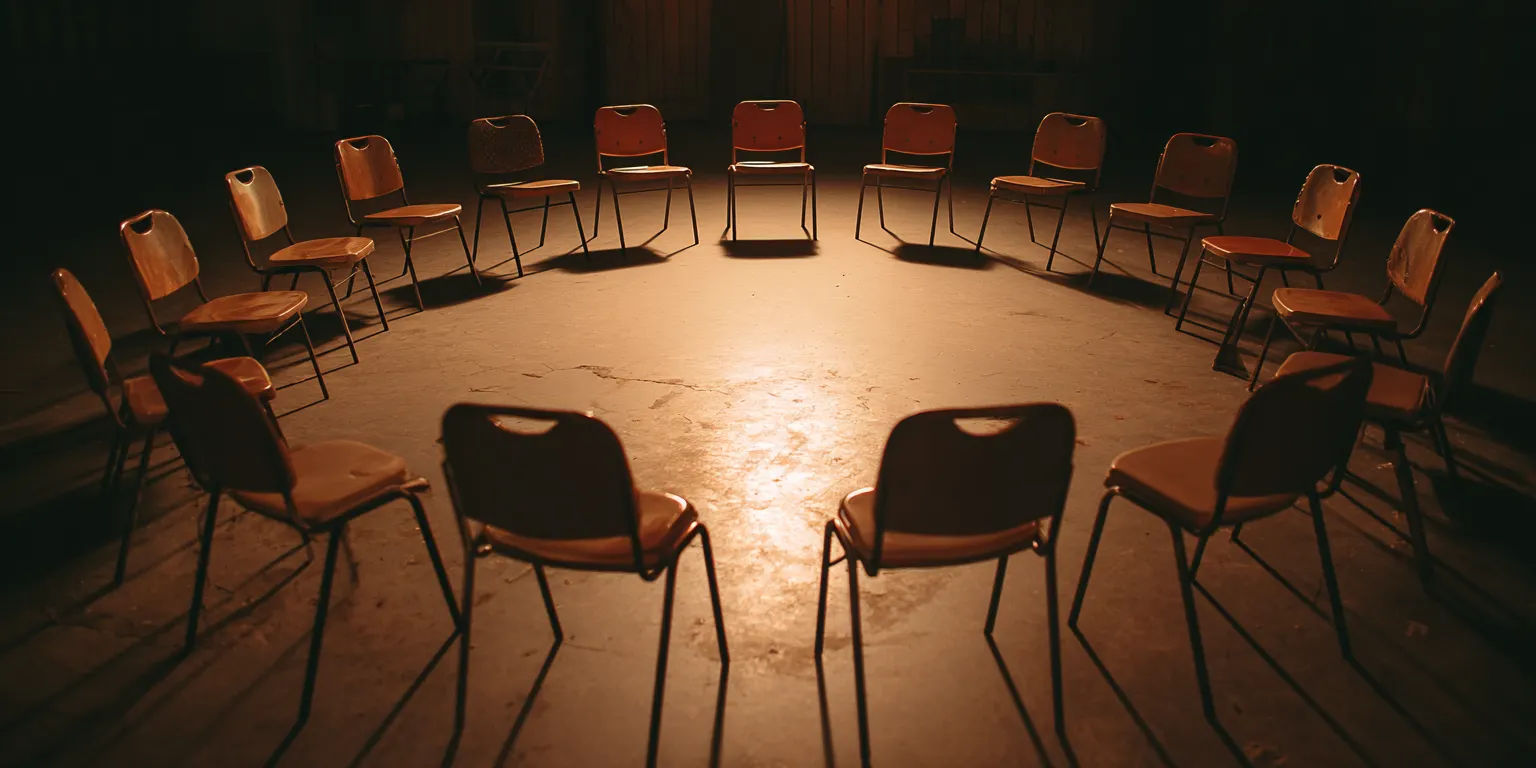
Before the first word is spoken, there is the room. Often a church basement or a community hall, it carries the faint scent of stale coffee and industrial cleaning fluid. The chairs are arranged in a circle, or something approximating one. They are mismatched, some metal and cold, others padded and worn. This arrangement might be the first thing you notice, an unspoken statement about sightlines. No one sits above anyone else. Everyone can, if they choose, see everyone else.
This geometry is where something begins. When you first arrive, your internal state might be one of collapse, a frantic and deafening noise of self-recrimination and fear. Hope is not even a remote consideration. The goal is simpler: to stop the shaking, to silence the internal monologue, to survive the next hour. The room offers none of the grand gestures of salvation. It offers a chair, a disposable coffee cup, and a quality of silence that is different from the silence of isolation. It is a shared silence, populated by the quiet breathing of others.
What does it mean for a space, in its simple arrangement, to hold a possibility that you cannot yet hold for yourself? The circle of chairs suggests a container. It seems to say, whatever you have brought in here with you, it can be held in this space. It will not break us. Before a story is told, before a hand is raised, the physical configuration of the room does its work. It makes a space for presence, a small clearing where the noise can, for a moment, subside.
A Grammar for What Comes Next
Someone speaks, sharing some portion of their experience. The stories themselves can be harrowing or mundane, but you’re often struck by something else entirely. It is the language, the specific turn of phrase, the description of a feeling once thought to be singular and shameful. To hear your own private terror given voice by a stranger across the room is a startling experience.
A man speaks of the morning dread, the physical weight of it on his chest. A woman describes the peculiar logic of a mind that believes one more drink will fix the problems created by drinking. These are not confessions seeking absolution. They are statements of fact, delivered without adornment. This sharing creates a common grammar for an experience that defies ordinary language. It builds a vocabulary for the unspeakable, which is the first step toward finding recovery and meaning.
The phrases are repeated across meetings, across cities. “One day at a time.” “Keep it simple.” “A disease of perception.” At first, they may sound like clichés. Yet over time, they begin to function as load-bearing structures. They are handles for concepts that are too heavy to lift alone. How does a shared language begin to build a world where a future tense feels possible again? A future that felt impossible begins to take shape in the words you hear, and eventually, the words you might speak.
The Smallness of the Ask
The central instruction of the program is perhaps its most radical. Do not concern yourself with forever. Do not even promise to stay sober for a year, or a week.
The ask is much smaller.
Just for today.
This reduction of scale is a profound psychological shift. The mountain of a lifetime of abstinence, an impossible and terrifying peak, is broken down into a single, manageable step. The feeling of being overwhelmed gives way to a sense of sobriety and purpose on a human scale.
This temporal modesty extends to the spiritual suggestions of the program. The idea of a “higher power” is often a stumbling block, evoking images of a dogmatic, interventionist deity. But in the context of the rooms, its function appears more pragmatic. It is an invitation to concede that your own mind, the same mind that created the problem, might not be the best instrument for solving it. The “power” can be the group itself, the quiet wisdom of the room, or the simple passage of time.
It is an act of humility, a willingness to entertain the notion that you don’t have to carry the entire weight of existence alone. It asks for a small opening, a crack in the certainty of self-will. What happens to the feeling of impossibility when the horizon of concern is drawn back to the radius of a single day?
The future, once a source of immense dread, becomes neutral territory. Hope, if it appears, does so not as a blazing sun, but as the faint light of dawn, just enough to see the next few feet of the path.
Living Alongside the Shadow
There are promises made in the literature of AA. The text speaks of a new freedom and a new happiness, of peace and serenity.
For many, these words ring true over time.
For others, and perhaps for all of us at some point, they feel distant, even mocking.
Life continues. People get sick, relationships end, grief arrives. The program does not offer an inoculation against human suffering.
A difficult truth settles in: sobriety is not a cure for life.
The shadow remains. The work is not to extinguish it, but to learn to live alongside it. The Promises of AA may be better understood not as a checklist of entitlements, but as a description of what becomes possible when you’re no longer consumed by the singular, exhausting task of drinking or not drinking.
The freedom mentioned is not a freedom from pain. It is a freedom to be present for it, to feel it without the immediate impulse to numb or escape.
This is where a more durable form of hope is forged. It is a quiet thing, a resilience born of endurance rather than triumph. It is the knowledge that a bad day does not have to become a bad life. It is the capacity to sit in a room with others who are also living alongside their own shadows and to know that you are not alone in that work. Can hope be measured not by the absence of struggle, but by the willingness to remain present within it?
A Belief Held in Common
Over time, a subtle shift occurs in your understanding of where hope comes from. The initial meetings may have been a desperate, self-centered act of survival. But as you continue to attend, you begin to listen differently. You listen not just for your own story, but for the story of the person sitting to your left, or the person making the coffee. A sense of shared, collective life emerges from the scattered narratives.
There are days when belief feels impossible. The words feel hollow, the rituals empty. On those days, you can come to a meeting and simply sit, letting the accumulated belief of the room do the work. The group holds the faith when the individual cannot. A person celebrating thirty years of sobriety offers a quiet testament to a newcomer that a different life is possible. That person’s presence is a form of borrowed evidence. This is the practical, observable mechanism of spirituality in AA.
This is the core of it. The hope is not located within any single person, but is a property of the group itself. It is a current that runs through the circle of chairs, an invisible thing made real by the continued presence of others. It existed before you arrived, and it will exist after you leave. You are invited, for a time, to draw from it.
What if hope is not something to be found, but something that is held for us by others until we are able to hold it for ourselves?