
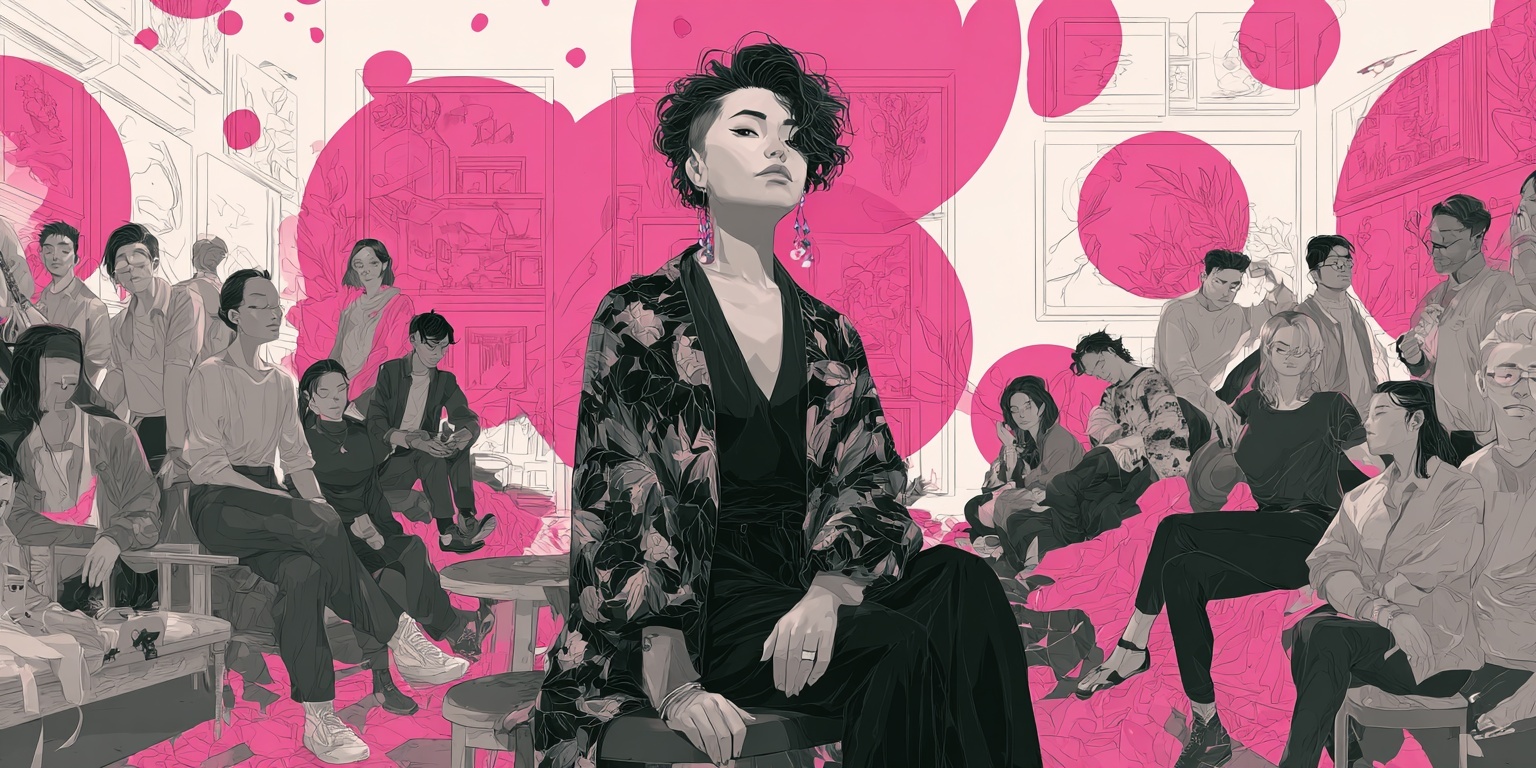
Recovery doesn’t erase the parts of you that never fit the script
I was three days sober when I walked into my first recovery meeting. The woman leading it was maybe in her 50s, talking about her grandchildren and her husband of thirty years, and all I could think was: these people have no idea what to do with me.
She wasn’t wrong, exactly.
I wasn’t wrong either.
I sat in the back and tried to make myself smaller, which was a familiar posture. I’d been making myself smaller since I was seventeen and told my parents I was attracted to girls as well as boys. Since my mother’s face went carefully blank and she said, in Mandarin, that she still loved me—but in a voice that sounded like she was eulogizing someone. Since my father stopped asking about my future, stopped mentioning grandchildren, stopped looking directly at me when we talked about anything that mattered.
I’d spent years of carrying that silence. Years of knowing I was the daughter they got instead of the daughter they wanted. Years of drinking to make that knowledge feel less like broken glass lodged in my chest.
And now I was here, sober, trying to figure out how to build a life I could stand to live in.
What Gets Carried
I knew I was bisexual before I had language for it. Middle school, maybe earlier. The feeling of being attracted to my best friend felt the same as the crush I had on the boy in my math class—urgent and confusing and completely outside my control. I didn’t tell anyone. I was already aware of being different in ways that mattered to my family: American-born to immigrant parents, more comfortable in English than Mandarin, interested in engineering instead of medicine.
Adding queer to that list felt dangerous.
When I finally came out at seventeen, I thought honesty would be enough. That if I just explained it clearly, if I was still their high-achieving daughter in every other way, they’d understand. My mother asked if I was sure. My father asked if I’d considered how this would affect the family. My younger brother stopped talking to me for three months.
What I learned was that conditional love feels worse than no love at all. Because they didn’t disown me. They didn’t throw me out or cut me off financially. They just—adjusted. Recalibrated their expectations downward. Started speaking about my future in vaguer terms, in ways that left room for disappointment they were already anticipating.
I became an expert at reading that disappointment. Learned to see it in the pause before my mother answered when friends asked about my life. Heard it in my father’s careful neutrality when I mentioned a girlfriend. Felt it in the way they stopped including me in certain family conversations, the ones about weddings and grandchildren and carrying on the family name.
The shame of that settled into my bones. It became the lens through which I understood myself: fundamentally wrong, inherently disappointing, acceptable only if I could make the other parts of myself impressive enough to compensate.
College felt like my chance to do that. To be excellent at something they valued, to prove I wasn’t a complete failure as a daughter. I threw myself into engineering, into being the student who never missed a deadline, who could solve problems other people found impossible. I thought if I was successful enough, maybe the disappointment about who I loved wouldn’t matter as much.
But the performance exhausted me. Keeping track of what I could say and what I couldn’t, who “knew” and who didn’t, which version of myself was safe to show in which context. I felt like I was living multiple lives badly instead of one life well.
Alcohol made all of it quieter. Made the edges softer. Made me feel less like I was failing at being myself every single day.
The Art of Disappearing
The drinking started socially—parties, study groups, the normal college experimentation everyone does. But somewhere around sophomore year it became something else. I started drinking alone in my apartment. Started needing it to fall asleep. Started planning my days around when I could drink next without anyone noticing.
I wasn’t drinking to celebrate. I was drinking to disappear.
To quiet the voice that said I was too queer for my family, too Asian for my white classmates, too serious for the party culture but too anxious to actually relax into any version of normal. To stop feeling the weight of my parents’ careful disappointment every time I came home. To make the loneliness feel less like drowning.
I managed to function. That’s what I told myself, anyway. I graduated on time. Got a job at a good firm. Maintained the surface appearance of having my life together. But underneath I was barely holding on, and I knew it.
The hangovers got worse. The blackouts more frequent. The mornings I woke up and couldn’t remember how I got home, what I’d said, who I’d hurt. The sick feeling of knowing I’d done something I couldn’t take back but having no clear memory of what.
I tried to stop on my own. Multiple times. Made it a few days, sometimes a week. Then something would happen—a call with my mother, a microaggression at work, the particular loneliness of being visibly queer in spaces that assume everyone is straight—and I’d be right back where I started.
What finally broke wasn’t dramatic. I didn’t lose my job or get a DUI or end up in the hospital. I just woke up one morning, twenty-six years old, and realized I couldn’t remember the last day I hadn’t thought about drinking. Couldn’t remember what I was like before alcohol became the organizing principle of my life.
I was disappearing into my own existence, becoming someone I didn’t recognize and didn’t particularly like.
So I called the number a friend had given me months earlier. Admitted out loud that I needed help. Showed up to that first meeting three days later, terrified and desperate and not at all sure this was going to work.
Spaces That Weren’t Built For Me
Early sobriety felt like learning to exist without skin. Everything was too loud, too bright, too much. All the feelings I’d been drowning for years came flooding back, and I had no idea how to handle them without alcohol.
The meetings helped, but they also highlighted how little I fit. Most people there were older. Straight. Talking about spouses and traditional family structures in ways that assumed everyone’s life looked like that. The program literature used language about God that assumed a specific kind of Christianity I’d never practiced. The prayers at the end of meetings referenced a higher power I wasn’t sure I believed in.
I didn’t see myself anywhere in those rooms.
Nobody talked about being queer. Nobody talked about family rejection or conditional acceptance or the particular shame of being a disappointment to immigrant parents. Nobody talked about navigating recovery when your identity itself had been treated as something to recover from.
I kept showing up anyway, mostly because I was too desperate to care about fitting in. I needed to not drink more than I needed to feel comfortable. So I sat in the back and took what was useful and tried not to think too hard about everything that didn’t apply to my life.
What I learned slowly was that the program was asking me to do something I’d never done before: be completely honest about my life and my thinking and the patterns that had gotten me here.
This terrified me. Because being honest meant admitting things I’d spent years hiding. Meant looking clearly at the ways I’d used alcohol to avoid dealing with my identity, my family, my own internalized shame about who I was. Meant examining the thoughts that led me to drink—the ones that said I was fundamentally unacceptable, that I needed to be someone else entirely, that the only way to survive was to numb everything I was feeling.
The program called this taking inventory. Looking at my life clearly, without the comfortable blur of alcohol softening the edges. Identifying the patterns of thinking that kept me trapped.
I resisted at first. Pushed back on the idea that I needed to examine my thoughts so carefully. But my sponsor—one of the few openly gay people in the meetings I attended—kept asking me questions that made me uncomfortable.
What’s the evidence for that thought? What would you tell a friend who was thinking this way? What happens if you choose to interpret this differently?
At first it felt mechanical. Artificial. Like I was trying to logic my way out of feelings that had nothing to do with logic. But slowly I started to see the patterns she was pointing to.
How my mind would spiral into shame about my sexuality, and that shame would make drinking feel inevitable. How I’d tell myself I was fundamentally broken, and use that story to justify giving up on sobriety. How I’d interpret every uncomfortable interaction as evidence that I didn’t belong anywhere, and use that loneliness to excuse isolating and drinking alone.
Learning to question those thoughts—to examine them instead of accepting them as truth—became as essential to my sobriety as anything else. Because the thoughts were the foundation. The drinking was just the coping mechanism I’d built on top.
Learning to Sit With What Hurts
Six months sober, I drove home for my brother’s birthday. My mother asked how I was doing, and I told her I’d stopped drinking. She looked confused, asked why. I said I was an alcoholic.
The silence that followed felt like falling.
She asked why I had to talk about it. Why I couldn’t just quietly not drink. Said she didn’t understand why I was making such a big deal out of everything—first the bisexual thing, now this. Asked if I was trying to embarrass the family.
I sat at her kitchen table and felt the familiar shame rise up, the voice that said I was too much, too difficult, too determined to be a disappointment. The part of me that wanted to apologize, to take it back, to be easier to love.
Instead I said: I’m doing this to stay alive. And I’m not going to apologize for it.
It was the first time I’d chosen my own wellbeing over her comfort. The first time I’d drawn a boundary that protected my sobriety instead of protecting her from having to think about my life.
She didn’t say anything. Just turned back to the dishes. My father changed the subject. We finished dinner in the careful silence I’d grown up with, the one that meant we were all pretending everything was fine.
I drove back to my apartment and cried for two hours. Called my sponsor, who listened and didn’t try to fix it. Went to a meeting that night even though I was exhausted, even though part of me wanted to skip it.
This became the pattern: choosing recovery even when it meant disappointing people. Setting boundaries even when it made me feel selfish. Showing up to meetings even when I didn’t feel like I belonged there. Examining my thoughts even when it was uncomfortable.
The work of early sobriety felt impossible some days. Like I was trying to rebuild my entire life from scratch while also learning to exist in my own skin for the first time. But I kept doing it because the alternative was going back to disappearing, and I’d already lost too many years to that.
What Sobriety Asked Me to Become
Recovery didn’t make me fit my family’s expectations any better. Didn’t make me straight or less complicated or easier to explain at family gatherings. What it did was strip away the option of avoiding any of it.
I had to learn to sit with my mother’s disappointment without drinking over it. To feel the loneliness of being the wrong daughter without numbing it into something manageable. To carry the weight of knowing my parents might never fully accept me, and build a life anyway.
I had to learn to challenge the thoughts that made that weight unbearable. To question the story I’d been telling myself about being fundamentally unworthy of love. To examine the evidence instead of accepting the narrative my shame kept offering.
Am I actually broken, or did I just grow up in a family that couldn’t accept who I was? Is disappointing my parents the same as being a disappointment? What would it mean to measure my worth by different standards?
These questions felt dangerous. Revolutionary, even. Because they suggested that maybe the problem wasn’t me. Maybe the problem was trying to force myself into shapes that were never going to fit.
I found meetings where other LGBTQ people showed up. Spaces where I didn’t have to explain or translate my experience. A sponsor who understood what it meant to navigate recovery when your identity already made you an outsider. I learned to adapt the program’s spiritual language to something that worked for me—not the God my parents had tried to teach me about, but something closer to collective wisdom, to the accumulated experience of people who’d survived what I was trying to survive.
I learned that I could take what was useful and leave the rest. That disagreeing with parts of the program didn’t mean I couldn’t benefit from other parts. That questioning things didn’t make me a bad recovery citizen—it made me someone who was learning to think for herself instead of accepting every narrative she was handed.
This felt like heresy sometimes. But it also felt like the first authentic thing I’d done in years.
It Gets Better
I work as a software engineer, solving problems that have actual solutions—a relief after years of trying to fix things that couldn’t be fixed with logic or effort or sheer determination to be good enough.
My relationship with my parents is still complicated. They know I’m sober. They don’t really understand what that means or why it matters. My mother still makes comments about my “lifestyle” when I mention my girlfriend. My father still changes the subject when I talk about recovery meetings.
But I’ve learned to hold their discomfort without letting it dictate my choices. To set boundaries that protect my sobriety even when those boundaries hurt. To accept that they may never give me the unconditional acceptance I wanted, and that their limitations don’t define my worth.
I still have days when the old thoughts surface. When I look at my life and see only the ways it deviates from what was expected of me. When perfectionism whispers that I should be further along, more healed, less affected by things that happened years ago.
The difference is that I have tools now. I notice those thoughts instead of accepting them as truth. I examine them the way I’d examine a bug in code—where did this come from? What assumptions am I making? What happens if I adjust the parameters?
I practice honesty in my relationships, which means being vulnerable in ways that still feel risky. I engage with my recovery community even when it’s inconvenient, because I know what happens when I isolate. I question the narratives that lead me toward shame or self-destruction. I choose to act based on what I value rather than what I fear.
Some days that feels powerful. Other days it feels like the bare minimum of survival. Both things are true, and I’ve learned to let them be.
What I Protect Now
Recovery gave me my voice back. Not in some dramatic moment of revelation, but gradually, in the accumulation of days where I showed up as myself. Where I chose honesty over hiding. Where I set boundaries instead of contorting myself into acceptable shapes.
Using that voice for something beyond my own survival feels like the natural extension of that gift. I speak at recovery events sometimes, particularly those focused on young people or LGBTQ folks. I talk about what it’s like to get sober when you don’t see yourself reflected in the stories being told. When the dominant narrative assumes experiences you’ve never had and a family that functions nothing like yours.
I’ve learned that my responsibility in recovery includes making space for people whose experiences differ from mine, just as others made space for me when I needed it. The program works through shared experience, through one person showing another that survival is possible.
I needed to see that as a young Asian American woman trying to get sober. Needed evidence that someone like me could build a life worth protecting. Now I try to be that visibility for others, because I know what it’s like to feel invisible in rooms full of people who are supposed to understand.
This is what I protect now: my sobriety, my honesty, my right to exist fully as myself. Recovery made that protection possible. Continuing to practice what keeps me sober—examining my thoughts, staying accountable, choosing connection over isolation—makes it sustainable.
The work never stops being work. I still have to challenge the thought patterns that lead toward shame. Still have to choose recovery principles over comfort. Still have to show up to meetings and call my sponsor and examine my thinking when I notice myself spiraling.
But I have better tools for it now. A clearer sense of why it matters. A life that feels like mine instead of a performance of someone else’s expectations.
I’m not the daughter my parents expected. I’m the daughter I’m learning to be. And most days, that feels like more than enough.